MergeScout vs LinearB: Which Engineering Metrics Tool Is Right for You? (2026)
An honest comparison of MergeScout and LinearB — features, pricing, setup, and which one fits your team size and needs.
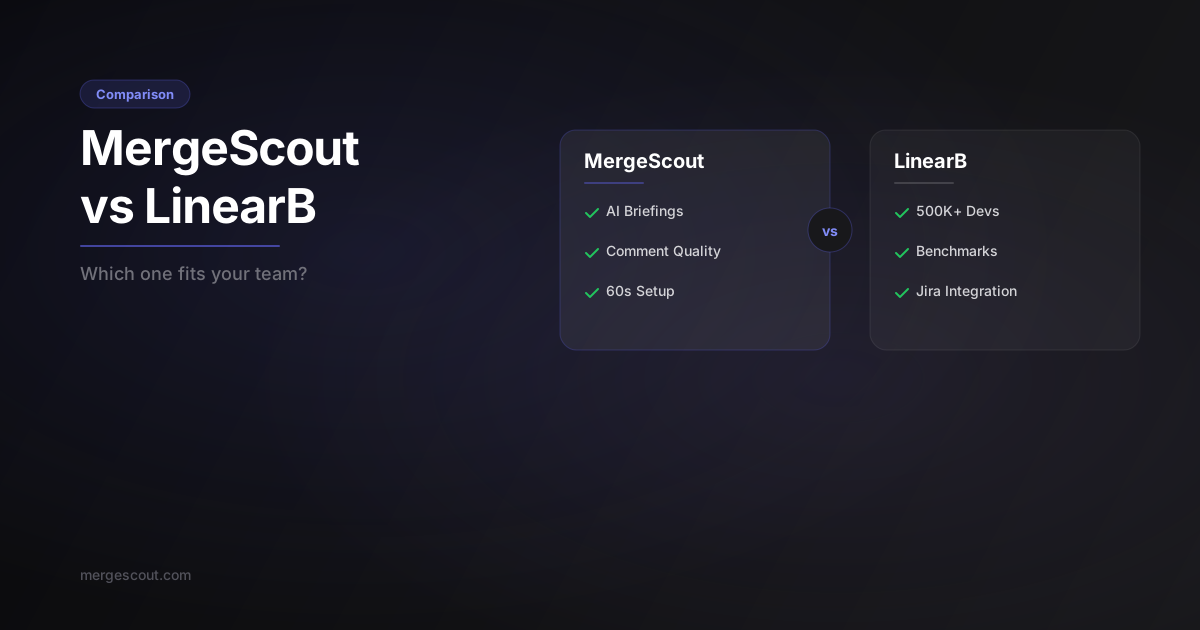
TL;DR: LinearB is built for enterprise teams (50-500+ engineers) with deep Jira integration and industry benchmarks. MergeScout is built for smaller teams (5-50 engineers) who want AI executive briefings, comment quality scoring, and 60-second setup from GitHub alone. Both have free tiers. Pick the one that matches your team size and workflow.
Why are engineering managers comparing these two tools?
Because both solve the same core problem: you shouldn’t have to dig through GitHub for 45 minutes to understand how your engineering team performed last week. Both tools pull data from your repos and surface the metrics that matter — cycle time, throughput, review quality, deployment frequency.
But they solve this problem very differently. LinearB is a $71M-funded enterprise platform that connects to Jira, Git, and your CI/CD pipeline to give you a full-stack view of engineering work. MergeScout is a focused, GitHub-native tool that uses AI to generate executive briefings and scores review quality at the comment level.
Neither is objectively better. They’re built for different teams at different stages. Here’s an honest breakdown.
Where does LinearB excel?
LinearB is a powerhouse for large engineering organizations. If you have 100+ engineers across multiple teams, LinearB was built for you.
Industry benchmarks. LinearB publishes an annual Software Engineering Benchmarks report with data from 500,000+ developers. That’s genuinely valuable — you can compare your team’s cycle time and throughput against industry medians. No other tool has benchmarks at that scale.
Full-stack visibility. LinearB connects to Jira (or Linear), Git, and CI/CD to correlate work items with code changes and deployments. If your VP wants to know “how long does it take from ticket creation to production,” LinearB can answer that. It tracks the full value stream, not just the code review portion.
WorkerB automation. Their automation engine can auto-assign reviewers, flag stale PRs, and enforce workflow rules. For large teams with complex routing needs, this saves real time.
Investment tracking. LinearB categorizes work into new features, bug fixes, tech debt, and operational work. If your leadership team asks “what percentage of our engineering effort goes to tech debt,” LinearB has the answer.
Enterprise-grade. SOC 2, SSO, role-based access, the whole package. When procurement asks for the security questionnaire, LinearB has it ready.
The trade-off? Setup takes 15-30 minutes minimum, and you get the most value when you also connect Jira. For teams that don’t use Jira (or use a lightweight alternative), a significant chunk of LinearB’s value proposition doesn’t apply.
Where does MergeScout excel?
MergeScout is an AI-powered engineering metrics dashboard that watches your GitHub repos and delivers executive briefings in seconds. It’s opinionated about what matters and fast to set up.
AI executive briefings. This is the headline feature no other tool offers. MergeScout generates a written narrative summary of your team’s performance — not a dashboard you have to interpret, but a briefing you can forward to your VP as-is. It highlights what changed, what’s concerning, and what’s going well. In natural language.
Comment quality scoring. MergeScout doesn’t just count review comments — it scores them. A “LGTM” is not the same as a detailed review that catches an edge case. This distinction matters enormously for understanding whether your code review process is actually working or just going through the motions.
PR review rounds as a first-class metric. Most tools bury review rounds or don’t track them at all. MergeScout treats review rounds — the number of back-and-forth cycles before a PR merges — as a core metric. It’s one of the strongest signals for process friction, and it’s front and center in every dashboard.
GitHub-native, no Jira required. If your team’s workflow lives in GitHub, MergeScout captures everything it needs. No Jira mapping, no issue tracker integration, no configuration. Connect your GitHub org and you’re done.
60-second setup. Authenticate with GitHub, select your repos, and MergeScout starts computing metrics immediately. There’s no 15-minute onboarding wizard. No fields to map. No “schedule a call with our solutions engineer.”
Free during beta. MergeScout is free to use right now. No credit card, no trial expiration.
How do the features compare side by side?
Here’s the direct comparison:
| Feature | MergeScout | LinearB |
|---|---|---|
| AI Executive Briefings | Yes (unique) | No |
| Comment Quality Scoring | Yes (unique) | No |
| PR Review Rounds | First-class metric | Partial |
| AI Adoption Tracking | Yes | Yes |
| DORA Metrics | Yes | Yes |
| Jira Required | No | Optional (but recommended) |
| Industry Benchmarks | No | Yes (500K+ developers) |
| Investment Tracking | No | Yes |
| Workflow Automation | No | Yes (WorkerB) |
| Setup Time | 60 seconds | 15-30 minutes |
| Free Tier | Yes (full beta) | Yes (limited) |
| Best For | 5-50 engineers | 50-500+ engineers |
Some context on the “partial” for LinearB’s PR review rounds: LinearB tracks iteration time and can surface review cycles, but it’s not a dedicated metric with its own dashboard, trends, and per-developer breakdowns the way MergeScout handles it.
What about pricing?
LinearB has a free tier (LinearB Free) that covers basic metrics for smaller teams. Their paid plans start at a per-seat price that scales with team size — you’ll need to talk to sales for exact numbers, but expect enterprise SaaS pricing. For a 50-person team, budget accordingly.
MergeScout is free during the beta period. When pricing launches, the goal is to stay accessible for small-to-mid teams. Current users get the full feature set at no cost.
Which tool is right for your team?
Choose MergeScout if:
- Your team is 5-50 engineers
- You want AI-generated briefings you can send to leadership without editing
- Code review quality matters to you (not just speed)
- Your workflow is GitHub-native (no Jira dependency)
- You want to be up and running in under a minute
- You want to try it free right now
Choose LinearB if:
- Your team is 50-500+ engineers
- You need to correlate Jira tickets with code changes
- Industry benchmarks are important for your planning
- You need investment tracking (new features vs. tech debt vs. bugs)
- Your procurement team requires enterprise security certifications
- You want workflow automation (auto-assign reviewers, flag stale PRs)
Consider both if:
- You’re a mid-size team (30-80 engineers) evaluating options
- You want to start with MergeScout’s free beta for quick insights and evaluate LinearB for long-term enterprise needs
There’s no wrong answer here. The wrong answer is not using any metrics tool and relying on gut feel and standup meetings to understand your team’s performance.
Can you use MergeScout and LinearB together?
Yes. They pull from the same GitHub data but surface different insights. Some teams use LinearB for investment tracking and Jira correlation while using MergeScout for AI briefings and comment quality analysis. There’s no conflict — both are read-only integrations with your GitHub repos.
That said, most teams under 50 engineers will find MergeScout covers their needs completely. Start there and evaluate whether you need LinearB’s enterprise features as you scale.
Frequently Asked Questions
Is MergeScout a direct competitor to LinearB?
Partially. Both are engineering metrics platforms, but they target different team sizes and emphasize different capabilities. LinearB is an enterprise tool with deep project management integration. MergeScout is a focused, AI-powered tool for teams that want fast insights from GitHub data. There’s overlap in core metrics (DORA, cycle time, throughput), but the unique features diverge significantly.
Does LinearB offer AI-generated reports?
As of 2026, LinearB does not generate narrative AI executive briefings. They provide dashboards, charts, and automated alerts, but the “written summary you can send to your VP” format is unique to MergeScout.
Can MergeScout replace LinearB for enterprise teams?
For teams over 100 engineers that rely on Jira correlation, investment tracking, and industry benchmarks, LinearB is still the stronger fit. MergeScout is purpose-built for teams of 5-50 engineers. If you need enterprise features, LinearB delivers them.
Which tool has better DORA metrics support?
Both track the four DORA metrics (deployment frequency, lead time, change failure rate, time to restore). LinearB has the edge on benchmarking your DORA scores against industry data. MergeScout has the edge on contextualizing DORA metrics within AI-generated briefings that explain what the numbers mean for your team.
How long does it take to see value from each tool?
MergeScout: minutes. Connect GitHub, and your first AI briefing is ready almost immediately. LinearB: days to weeks. The initial setup is 15-30 minutes, but getting full value requires connecting Jira, configuring team mappings, and waiting for enough data to populate meaningful benchmarks.